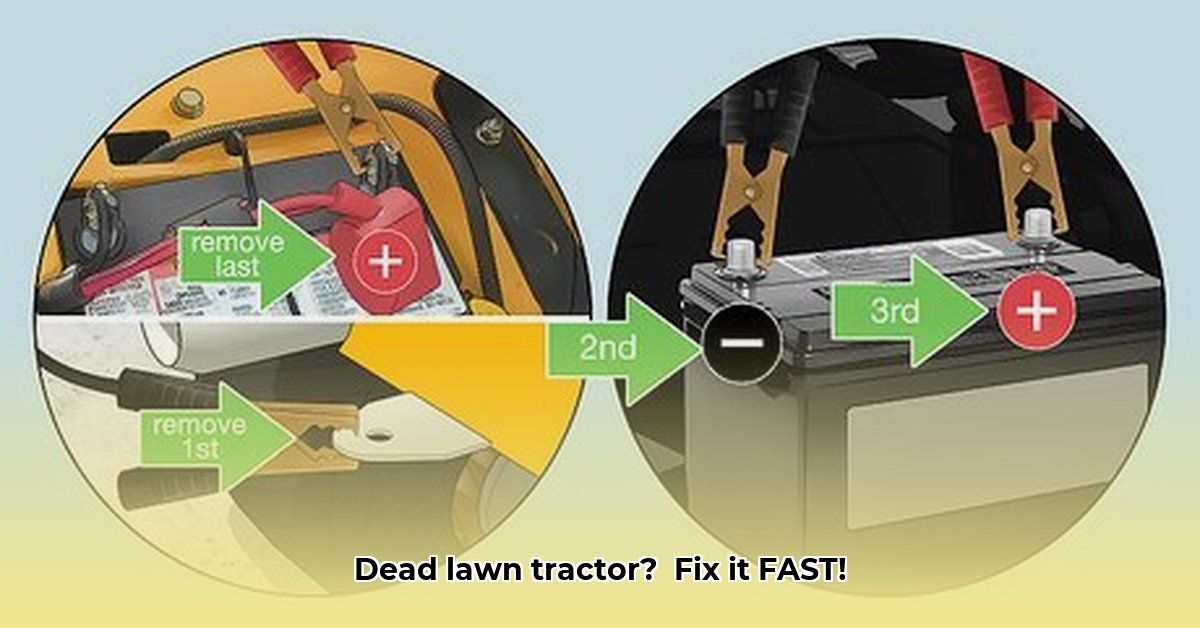
Keeping your lawn tractor's battery healthy is key to a smooth mowing season. A weak battery can leave you stranded, and replacements are costly. This guide provides clear steps for checking, understanding, and maintaining your lawn tractor battery's voltage, saving you time and money. Let's get started! For more on jump-starting, see this helpful guide.
Checking Your Lawn Tractor Battery Voltage
A quick voltage check can prevent costly repairs. You'll need a multimeter (a device that measures voltage – readily available at auto parts stores).
- Safety First: Always disconnect the negative (-) battery terminal before starting. This prevents electrical shocks.
- Multimeter Setup: Set your multimeter to measure DC voltage (often marked "V"). Most lawn tractors use 12V batteries, but check your owner's manual.
- Connecting the Multimeter: Carefully connect the red lead to the positive (+) terminal and the black lead to the negative (-) terminal. Ensure a secure connection.
- Interpreting the Reading: A fully charged 12V battery shows around 12.6V. 12.2V-12.6V suggests a partial charge; below 12.2V indicates a need for charging; below 11.8V signals a likely problem. Adjust these values proportionally for 6V batteries. Isn't it surprising how a simple voltage reading can reveal so much about your battery's health?
Understanding Battery Types: Lead-Acid, AGM, and Lithium-Ion
Choosing the right replacement battery depends on your needs and budget. Here's a comparison:
| Battery Type | Typical Lifespan | Maintenance Needs | Typical Cost | Pros | Cons |
|---|---|---|---|---|---|
| Lead-Acid | 3-5 years | Moderate | Low | Inexpensive, widely available | Requires periodic watering, prone to sulfation, shorter lifespan, can leak. |
| AGM | 5-7 years | Low | Medium | Spill-proof, longer lifespan, less maintenance | More expensive than lead-acid, slightly more vulnerable to deep discharge. |
| Lithium-Ion | 7-10+ years | Minimal | High | Longest lifespan, lightweight, high power output, efficient charging, superior cold-cranking performance. | Most expensive, sensitive to overcharging and extreme temperatures. |
Did you know that Lithium-ion batteries, despite their higher initial cost, often prove more economical in the long run due to their extended lifespan?
Troubleshooting Low Voltage: Beyond a Dead Battery
Low voltage doesn't always mean a dead battery. Let's explore other possibilities:
- Check the Terminals: Corrosion on the terminals is a common culprit. Clean them with a wire brush and a baking soda paste. Reconnect securely and retest the voltage. Cleaning corroded terminals is often a quick fix for low voltage, boosting performance with minimal effort.
- Inspect the Charging System: A faulty alternator or generator prevents proper recharging. This often requires professional help.
- Examine the Wiring: Check for damaged or loose wires. Replace any faulty wiring.
Selecting and Replacing Your Battery
Choosing the right replacement ensures your lawn tractor runs smoothly.
- Check Specifications: Consult your owner's manual for voltage (6V or 12V), cold cranking amps (CCA), and reserve capacity (RC) ratings. Knowing these specifications is vital for choosing a compatible replacement battery.
- Safe Disconnect: Disconnect the negative (-) terminal, then the positive (+).
- Installation: Carefully install the new battery. Connect the positive (+) terminal first, then the negative (-). Secure all connections.
- Test: Check all connections before starting your engine.
Battery Maintenance: Simple Steps for Longevity
Regular maintenance extends battery life significantly.
- Keep Terminals Clean: Regularly clean the terminals to prevent voltage loss.
- Proper Charging: Avoid completely discharging the battery.
- Storage: Store the battery in a cool, dry place when not in use.
- Battery Tender (Optional): A battery tender maintains a proper charge during periods of inactivity. Regular maintenance practices can add years to the life of your lawn tractor battery.
Safety Precautions
- Always wear safety glasses and gloves when working with batteries and electrical systems.
- Never work near water or in damp conditions.
- If you're uncertain about any step, consult a qualified mechanic.
Key Takeaways: Maximize Your Lawn Tractor's Lifespan
- Regular voltage checks are essential for preventing costly repairs. A proactive approach saves you time and money in the long run.
- Different battery types offer varying lifespans and maintenance requirements. Choosing the right battery type aligns with your budget and usage patterns.
- Simple maintenance significantly extends battery life, lowering your overall ownership cost.